7.1 - Small Appliance Definition and Examples
Module: Type I Small Appliances
Regulatory verification date: August 11, 2026
Primary authority: Current 40 CFR § 82.152 definition of small appliance and current EPA Section 608 technician-certification and Type I test-topic guidance
Course role: Establishes the complete regulatory definition of a small appliance, identifies representative Type I equipment, and develops a reliable classification method before later sections address Type I exclusions, recovery requirements, access fittings, and recovery techniques
Learning Objectives
After completing this section, a student should be able to:
- State the complete current Section 608 definition of a small appliance.
- Explain why all four defining conditions must be satisfied:
- Fully manufactured at a factory.
- Charged at a factory.
- Hermetically sealed at a factory.
- Contains 5 pounds or less of refrigerant.
- Explain why a refrigerant charge of 5 pounds or less does not, by itself, make an appliance a Type I small appliance.
- Distinguish the regulatory phrase hermetically sealed in a factory from the separate concept of a hermetic compressor.
- Identify common small-appliance examples, including refrigerators, freezers, room air conditioners, packaged terminal units, dehumidifiers, under-the-counter ice makers, vending machines, and drinking-water coolers.
- Recognize additional examples specifically included in the current federal definition, such as portable room air conditioners and certain medical or industrial research refrigeration equipment.
- Use equipment construction, factory-charge information, nameplate data, and manufacturer information to classify an unfamiliar appliance.
- Explain the relationship between Type I certification and the small-appliance definition.
- Recognize when an appliance should be evaluated further rather than classified from appearance alone.
- Apply the small-appliance definition to representative EPA 608 examination scenarios.
Introduction
Type I is the Section 608 certification category associated with servicing small appliances.
The word small can be misleading.
In ordinary conversation, a person might call equipment small because it:
- Fits on a countertop.
- Contains only a few pounds of refrigerant.
- Uses a small compressor.
- Operates from a standard electrical receptacle.
- Serves only one room.
- Can be moved by one or two people.
None of those characteristics, by itself, establishes the Section 608 regulatory classification.
The current federal definition is specific.
A small appliance is an appliance that is:
Fully manufactured at a factory
+
Charged at a factory
+
Hermetically sealed at a factory
+
Contains 5 lb or less of refrigerant
Every condition matters.
A useful classification rule is:
ALL FOUR CONDITIONS SATISFIED
→ small appliance
→ Type I service category
but:
ONLY SOME CONDITIONS SATISFIED
→ do not classify as Type I from charge or physical size alone
→ evaluate under the appropriate appliance category
The current federal definition also provides representative examples. These examples help students recognize common Type I equipment, but the definition controls the classification.
This distinction is one of the most important ideas in Module 7.
Key Concepts
1. Current Federal Definition
Current 40 CFR § 82.152 defines a small appliance as an appliance that is:
- Fully manufactured in a factory.
- Charged in a factory.
- Hermetically sealed in a factory.
- Charged with 5 pounds or less of refrigerant.
The definition then lists representative equipment categories.
These include:
- Refrigerators.
- Freezers.
- Medical or industrial research refrigeration equipment.
- Room air conditioners.
- Window air conditioners.
- Portable air conditioners.
- Packaged terminal air heat pumps.
- Dehumidifiers.
- Under-the-counter ice makers.
- Vending machines.
- Drinking-water coolers.
The regulation says the examples are not limited to the listed equipment.
Therefore:
An appliance can qualify as a small appliance even if its equipment name does not appear in the example list, provided it satisfies the complete regulatory definition.
Likewise:
An appliance does not qualify merely because it resembles one of the examples if it does not satisfy the defining conditions.
2. The Four-Condition Test
A reliable Type I classification begins with four questions.
| Classification Question | Required Answer |
|---|---|
| Was the appliance fully manufactured at a factory? | Yes |
| Was the appliance charged with refrigerant at a factory? | Yes |
| Was the refrigerant circuit hermetically sealed at a factory? | Yes |
| Does the appliance contain 5 lb or less of refrigerant? | Yes |
The result is:
YES + YES + YES + YES
→ small appliance
If any required answer is:
NO
the appliance does not meet the small-appliance definition on that basis.
3. “Five Pounds or Less” Is Necessary but Not Sufficient
A common examination error is:
Charge ≤ 5 lb
→ Type I
That shortcut is incorrect.
The correct reasoning is:
Charge ≤ 5 lb
+
factory manufactured
+
factory charged
+
factory hermetically sealed
→ Type I small appliance
A field-connected refrigeration or air-conditioning system can contain:
3 lb
4 lb
5 lb
and still fail the small-appliance definition because it was not completely charged and hermetically sealed at the factory.
Therefore:
Charge size is only one part of the definition.
4. The Five-Pound Value Refers to the Appliance Refrigerant Charge
The controlling limit is:
5 lb or less of refrigerant
The value does not refer to:
- Appliance shipping weight.
- Compressor weight.
- Recovery-cylinder capacity.
- Refrigerant container size.
- Amount of refrigerant recovered during one service visit.
- Amount of refrigerant remaining after a leak.
The classification concerns the refrigerant charge associated with the appliance under the regulatory definition.
5. Physical Size Does Not Control
A small appliance can be physically large enough to:
- Stand on the floor.
- Serve a hotel room.
- Contain a vending cabinet.
- Contain laboratory refrigeration equipment.
Conversely, physically compact equipment can fail the definition.
Therefore:
physical dimensions
≠
Section 608 small-appliance classification
The construction and refrigerant-charge conditions control.
6. “Factory Manufactured” Means the Appliance Is Completed as an Appliance at the Factory
The first requirement is that the appliance be fully manufactured at a factory.
The key distinction is between:
complete factory appliance
and:
refrigerant system assembled or completed in the field
A household refrigerator is typically delivered as a complete refrigeration appliance.
A conventional residential split system, by contrast, normally requires field connection of:
- Outdoor unit.
- Indoor coil.
- Refrigerant piping.
That field-connected arrangement should not be called a small appliance merely because the total charge happens to be below 5 pounds.
Detailed boundary cases are reserved for Section 7.2 - Type I Exclusions and Boundary Cases.
7. “Factory Charged” Means the Refrigerant Charge Is Installed at the Factory
A small appliance must be charged at a factory.
This means the completed appliance leaves the factory with its intended refrigerant charge already installed.
A system that requires the installer to establish the appliance’s refrigerant charge in the field does not satisfy this part of the definition.
This is another reason not to classify an appliance using charge quantity alone.
8. “Hermetically Sealed at a Factory” Describes the Appliance Refrigerant Circuit
The small-appliance definition requires the appliance to be hermetically sealed in a factory.
For classification purposes, the important idea is:
factory-completed refrigerant circuit
→ sealed before the appliance leaves the factory
This does not mean that the appliance can never be serviced.
Small appliances may contain:
- Process stubs.
- Factory access points.
- Service fittings.
- Tubing that can later be accessed by an appropriate service method.
Section 7.4 develops these access methods.
The regulatory phrase also should not be confused with the construction of the compressor itself.
9. “Hermetically Sealed Appliance” Is Not the Same as “Hermetic Compressor”
A hermetic compressor has the motor and compressor enclosed within a welded or sealed compressor shell.
That is a compressor-construction term.
The small-appliance definition, however, asks whether the appliance refrigerant circuit was hermetically sealed at the factory.
Therefore:
Hermetic compressor
≠
automatic Type I classification
A field-connected split system commonly contains a hermetic compressor but is not a small appliance because the complete appliance refrigerant circuit is not factory charged and hermetically sealed as one completed appliance.
This distinction is especially useful on the examination.
10. Type I Certification Is Tied to Servicing Small Appliances
EPA’s current certification guidance identifies:
Type I
→ servicing small appliances
Type I questions therefore emphasize topics such as:
- Small-appliance definition.
- Recovery requirements.
- Operating versus nonoperating compressor.
- System-dependent recovery.
- Access fittings.
- Recovery techniques.
- Type I safety.
The detailed recovery rules begin in Section 7.3.
11. The Definition Is More Reliable Than the Equipment Name
Suppose a question says:
portable refrigeration unit
That name alone may not be enough.
Ask:
- Was it fully manufactured at a factory?
- Was it factory charged?
- Was it factory sealed?
- Does it contain 5 lb or less?
The same reasoning applies to unfamiliar:
- Laboratory equipment.
- Specialty cooling equipment.
- Beverage equipment.
- Commercial appliances.
The definition should be applied before guessing from the product name.
Representative Small-Appliance Examples
1. Household Refrigerators
Household refrigerators are classic Type I examples.
A typical unit is:
- Completely assembled at a factory.
- Charged at the factory.
- Factory sealed.
- Charged well below the 5-pound limit.
Typical refrigeration components are contained within one appliance assembly:
compressor
→ condenser
→ metering device
→ evaporator
→ compressor
The appliance may have no permanent service valves from the factory, which is one reason Type I service often involves a process stub or temporary access fitting.
2. Household Freezers
Household freezers follow the same general classification logic as household refrigerators.
Examples include:
- Upright freezer.
- Chest freezer.
- Combination refrigerator/freezer appliance.
The current regulatory definition also includes refrigerators and freezers designed for:
- Home use.
- Commercial use.
- Consumer use.
Therefore, the word:
commercial
does not automatically exclude a refrigerator or freezer from the small-appliance definition.
The complete four-condition test still controls.
3. Window Air Conditioners
A window air conditioner is a common Type I example.
The complete refrigeration system is normally factory assembled in one cabinet.
The appliance is generally:
- Factory manufactured.
- Factory charged.
- Factory sealed.
- Within the 5-pound charge limit.
Do not confuse a window air conditioner with a conventional split-system air conditioner merely because both cool one room.
4. Portable Room Air Conditioners
The current regulatory definition specifically includes portable air conditioners within room air conditioners.
A typical portable room air conditioner contains:
- Compressor.
- Indoor heat exchanger.
- Outdoor-side heat exchanger.
- Refrigerant piping.
within the factory-completed appliance.
An air duct may be connected to a window to reject heat, but that air duct is not a field-installed refrigerant line.
Therefore the presence of an installation hose for air does not by itself make the unit field-connected refrigeration equipment.
5. Packaged Terminal Units
Packaged terminal equipment is commonly installed through an exterior wall and serves an individual room or zone.
Examples include:
- Packaged terminal air conditioners.
- Packaged terminal heat pumps.
The current small-appliance definition specifically includes packaged terminal air heat pumps among the room-air-conditioning examples.
For exam preparation, the controlling questions remain:
- Factory manufactured?
- Factory charged?
- Factory sealed?
- 5 pounds or less?
Do not classify equipment solely from the abbreviation PTAC or PTHP if the question provides facts that contradict the definition.
6. Dehumidifiers
A refrigerant-type dehumidifier uses a refrigeration circuit to cool air below its dew point so moisture condenses.
Typical components include:
- Compressor.
- Evaporator.
- Condenser.
- Metering device.
These components are normally contained within one factory-completed appliance.
Dehumidifiers are specifically listed in the current federal small-appliance definition.
7. Under-the-Counter Ice Makers
Under-the-counter ice makers are specifically listed as small-appliance examples.
These units typically contain a compact refrigeration system that:
- Freezes water.
- Releases the ice.
- Repeats the production cycle.
Do not confuse:
under-the-counter ice maker
with a larger field-installed refrigeration plant serving remote ice-making equipment.
The actual construction still controls.
8. Vending Machines
Vending machines with refrigeration systems can qualify as small appliances.
Examples include machines that cool:
- Bottled drinks.
- Canned drinks.
- Refrigerated food.
A vending machine can be physically large, which reinforces:
small appliance
≠
small cabinet
9. Drinking-Water Coolers
Drinking-water coolers are specifically included in the current federal definition.
A typical refrigerated water cooler contains a small factory-completed vapor-compression system that cools a water reservoir or heat exchanger.
10. Medical or Industrial Research Refrigeration Equipment
The current federal definition also includes medical or industrial research refrigeration equipment when the equipment satisfies the small-appliance conditions.
This is important because students may incorrectly assume:
industrial
→ automatically Type II
or:
medical
→ special non-Type-I category
Those assumptions are not valid.
The complete definition controls.
Small Appliance Classification Table
| Equipment Example | Common Type I Recognition | What Still Controls |
|---|---|---|
| Household refrigerator | Common small appliance | Complete regulatory definition |
| Household freezer | Common small appliance | Complete regulatory definition |
| Window air conditioner | Common small appliance | Complete regulatory definition |
| Portable room air conditioner | Specifically included | Complete regulatory definition |
| Packaged terminal unit | Common / specifically represented in definition | Complete regulatory definition |
| Dehumidifier | Specifically included | Complete regulatory definition |
| Under-the-counter ice maker | Specifically included | Complete regulatory definition |
| Refrigerated vending machine | Specifically included | Complete regulatory definition |
| Drinking-water cooler | Specifically included | Complete regulatory definition |
| Medical/research refrigerator | Can qualify | Complete regulatory definition |
| Compact field-connected split system | Do not assume Type I | Field construction and charge conditions must be evaluated |
| Factory appliance over 5 lb | Not a small appliance under this definition | Charge exceeds limit |
Technical and Regulatory Details
1. Regulatory Wording Controls
The current regulatory definition appears in:
40 CFR § 82.152
The core wording is:
fully manufactured
+
charged
+
hermetically sealed
in a factory
+
5 lb or less of refrigerant
This definition should be used whenever an exam question asks whether an appliance qualifies as a small appliance.
2. EPA’s Type I Test Topics Begin With the Definition
EPA’s current Section 608 test-topic page places:
Definition of "small appliance"
at the beginning of the Type I Recovery Requirements topic list.
This is logical because the recovery rule cannot be selected correctly until the appliance is classified correctly.
The sequence for Module 7 is therefore:
Classify appliance
→ determine Type I applicability
→ select Type I recovery requirement
→ select recovery technique
3. Small-Appliance Definition and Technician Certification Are Related but Distinct
The definition answers:
What equipment is a small appliance?
The certification rule answers:
What certification applies to servicing it?
Current EPA guidance identifies Type I as the certification for servicing small appliances.
Another important distinction appears during disposal:
- Type I certification applies to servicing small appliances.
- The Section 608 technician definition contains a certification exception for the disposal of small appliances.
- Refrigerant-recovery and safe-disposal requirements still apply during disposal.
The disposal exception was developed in Section 6.9 and will be revisited in Section 7.8.
4. Refrigerant Family Does Not Determine Type I by Itself
A small appliance can use different refrigerants depending on:
- Equipment age.
- Application.
- Manufacturer.
- Product generation.
The Type I classification is not established merely because an appliance uses a particular refrigerant.
Therefore:
refrigerant identity
≠
small-appliance definition by itself
The appliance-construction and charge criteria still control.
5. Safety Classification Does Not Replace Appliance Classification
A refrigerant safety designation such as:
A1
A2L
A3
describes toxicity and flammability characteristics.
It does not tell you whether the equipment is Type I.
For example, modern small appliances can use refrigerants with different safety classifications.
The technician must separately determine:
- Is it a small appliance?
- What refrigerant does it contain?
- What safety procedures and service tools are appropriate?
Refrigerant safety classifications were developed in Section 6.4.
6. Nameplate and Manufacturer Information Are Useful
When an unfamiliar appliance must be classified, useful information includes:
- Refrigerant designation.
- Factory refrigerant charge.
- Model number.
- Product type.
- Factory construction.
- Installation instructions.
- Whether refrigerant tubing must be connected in the field.
A nameplate that shows:
Factory charge: 4.0 lb
does not alone prove that all Type I conditions are satisfied.
It must be combined with construction information.
7. Charge Lost Through a Leak Does Not Reclassify the Appliance
Suppose an appliance was designed with a charge above 5 pounds but now contains less than 5 pounds because of a leak.
The reduced amount remaining in the circuit does not convert the equipment into a small appliance.
Likewise, Type I classification should not be based on:
amount currently recovered
or:
amount currently remaining after leakage
Classification is based on what the appliance is under the regulatory definition.
8. Adding Refrigerant During Service Does Not Redefine Factory Construction
If a qualifying small appliance later requires service and refrigerant is added, the service activity does not retroactively mean the appliance was not factory charged.
The classification question concerns the appliance’s factory manufacture/charge/sealing characteristics.
However, modifying an appliance or system in an unusual way may create a boundary case that should be evaluated carefully.
Section 7.2 addresses unusual and borderline scenarios.
A Practical Type I Identification Procedure
Use this procedure when the appliance classification is not immediately obvious.
Step 1 — Identify the Equipment
Record:
- Equipment type.
- Manufacturer/model.
- Refrigerant.
- Nameplate charge.
Step 2 — Ask Whether the Appliance Was Fully Manufactured at a Factory
If the refrigeration system required field completion:
do not classify as a small appliance from charge alone
Step 3 — Ask Whether It Was Factory Charged
If the installer had to establish the refrigeration charge in the field:
small-appliance factory-charge condition is not satisfied
Step 4 — Ask Whether the Appliance Refrigerant Circuit Was Factory Sealed
Do not confuse this with merely having a hermetic compressor.
Ask whether the complete appliance refrigeration circuit was sealed at the factory.
Step 5 — Check Refrigerant Charge
Confirm:
5 lb or less
Step 6 — Apply the Four-Condition Test
Factory manufactured?  YES
Factory charged?       YES
Factory sealed?        YES
≤ 5 lb refrigerant?    YES
                       ↓
                SMALL APPLIANCE
Step 7 — Confirm the Service Category
For servicing:
small appliance
→ Type I
Step 8 — If Uncertain, Do Not Guess From Appearance
Check:
- Manufacturer documentation.
- Current regulatory definition.
- Equipment construction.
Then proceed to the boundary-case analysis in Section 7.2 if necessary.
Important Terms
Factory Charged
Factory charged means the appliance receives its refrigerant charge as part of the factory manufacturing process rather than requiring establishment of the appliance charge during field installation.
Factory Manufactured
For Type I classification, the appliance must be fully manufactured at a factory rather than requiring field assembly of the refrigeration circuit into the completed appliance.
Factory Hermetically Sealed
For the small-appliance definition, the appliance refrigerant circuit is sealed at the factory as part of the completed appliance.
This term should not be confused with the separate compressor-construction term hermetic compressor.
Hermetic Compressor
A hermetic compressor contains the motor and compressor within a sealed shell.
A hermetic compressor alone does not make the entire appliance a Type I small appliance.
Nameplate Charge
The refrigerant quantity identified by the equipment manufacturer on the appliance nameplate or product information.
It is useful for classification, but charge quantity alone does not establish Type I status.
Packaged Terminal Air Conditioner
A self-contained room air-conditioning appliance designed for installation through a wall or similar building opening.
Whether a particular unit qualifies as a small appliance is determined by the complete regulatory definition.
Packaged Terminal Heat Pump
A packaged terminal unit capable of heating by reversing the refrigeration cycle as well as providing cooling.
The current small-appliance definition specifically includes packaged terminal air heat pumps among room-air-conditioning equipment.
Room Air Conditioner
A factory-completed appliance intended to condition a room or localized space.
The current definition includes examples such as:
- Window air conditioners.
- Portable air conditioners.
- Packaged terminal air heat pumps.
Small Appliance
A small appliance is an appliance that is fully manufactured, charged, and hermetically sealed in a factory with 5 pounds or less of refrigerant.
Type I Certification
Type I is the Section 608 certification category for servicing small appliances.
Figures and Diagrams
Figure 7.1.1
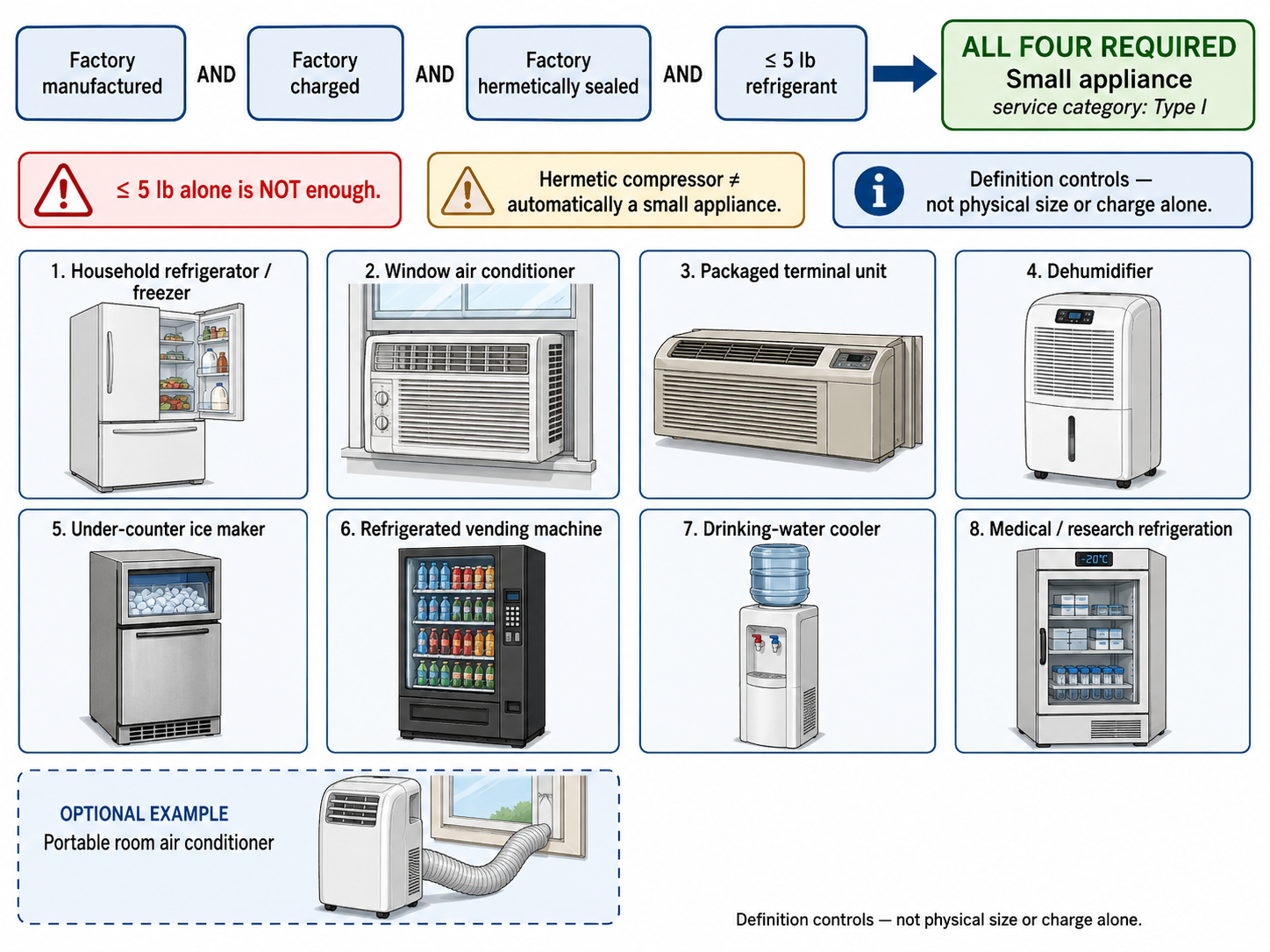
Figure 7.1.1 – Representative Type I small appliances and the four conditions that define the category.
AI-generated instructional figure: It may contain visual inaccuracies. Use the accompanying lesson text and cited authoritative sources to verify technical and regulatory details.
EPA 608 Exam Focus
What Students Must Remember
The Type I classification rule is:
Fully manufactured at factory
+
Factory charged
+
Factory hermetically sealed
+
5 lb or less of refrigerant
→ SMALL APPLIANCE
For service:
Small appliance
→ Type I
High-Priority Exam Traps
Trap 1 — Charge Alone
4 lb field-connected split system
does not automatically mean:
Type I
because the factory manufacture/charge/sealing conditions must also be satisfied.
Trap 2 — Physical Size
A large vending machine can still qualify as a small appliance.
A physically small split system can fail the definition.
Trap 3 — Hermetic Compressor
A hermetic compressor does not prove the entire appliance is factory hermetically sealed as required by the small-appliance definition.
Trap 4 — Commercial Equipment
The federal definition includes refrigerators and freezers designed for home, commercial, or consumer use.
Therefore:
commercial
≠
automatic Type II
Trap 5 — Familiar Equipment Name
A familiar product name helps recognition, but the complete definition controls when the question provides enough construction information to test the classification.
Representative Recognition List
Know these common examples:
- Refrigerator.
- Freezer.
- Window air conditioner.
- Portable room air conditioner.
- Packaged terminal unit.
- Dehumidifier.
- Under-the-counter ice maker.
- Refrigerated vending machine.
- Drinking-water cooler.
- Qualifying medical/research refrigeration equipment.
Fast Classification Method
When a question gives an unfamiliar appliance:
1. Factory manufactured?
2. Factory charged?
3. Factory sealed?
4. ≤ 5 lb?
Only after checking all four should you classify it as a small appliance.
Common Mistakes and Confusing Points
Mistake 1: Using Only the Five-Pound Rule
The 5-pound limit is one condition, not the complete definition.
Mistake 2: Assuming “Small” Means Physically Small
Regulatory classification is based on factory construction and charge, not cabinet dimensions.
Mistake 3: Confusing a Hermetic Compressor With a Hermetically Sealed Appliance
A field-connected Type II system can contain a hermetic compressor.
The complete appliance must satisfy the factory conditions.
Mistake 4: Assuming Every Refrigerator Is Automatically Type I
Refrigerators and freezers are listed examples, but the complete regulatory definition still controls.
Mistake 5: Assuming Commercial Use Prevents Type I Classification
The current definition specifically includes refrigerators and freezers designed for commercial use when they satisfy the definition.
Mistake 6: Calling a Mini-Split Type I Because Its Charge Is Small
A conventional field-connected mini-split does not become a small appliance merely because the refrigerant quantity is below 5 pounds.
Detailed boundary cases are covered in Section 7.2.
Mistake 7: Confusing an Air Hose With a Refrigerant Line
A portable room air conditioner can use an air exhaust hose while the refrigeration circuit remains entirely factory completed and sealed.
Mistake 8: Classifying From Refrigerant Type
The refrigerant designation does not by itself determine Type I status.
Mistake 9: Classifying From Voltage or Plug Type
A 120-V plug-in appliance is not automatically Type I, and voltage is not part of the federal small-appliance definition.
Mistake 10: Using the Amount Currently Remaining After a Leak
A leak that reduces the amount remaining below 5 pounds does not automatically reclassify the appliance.
Concept-Check Questions
Question 7.1-1
Which combination correctly describes a Section 608 small appliance?
A. Any appliance that contains 5 pounds or less of refrigerant
B. Any residential appliance that uses a hermetic compressor
C. An appliance fully manufactured, charged, and hermetically sealed at a factory with 5 pounds or less of refrigerant
D. Any portable appliance that plugs into a 120-V receptacle
Question 7.1-2
A field-connected split-system air conditioner contains 4 pounds of refrigerant. Why is the 4-pound charge not enough to classify it as Type I?
A. Type I equipment must contain exactly 5 pounds.
B. The complete definition also requires factory manufacture, factory charging, and factory hermetic sealing.
C. Type I applies only to refrigerators.
D. Any air conditioner is automatically Type II.
Question 7.1-3
Which statement correctly distinguishes a hermetic compressor from the small-appliance definition?
A. Every appliance with a hermetic compressor is Type I.
B. A hermetic compressor describes compressor construction, while the small-appliance definition applies factory-manufacture, factory-charge, factory-sealing, and charge conditions to the appliance.
C. Type I appliances cannot contain hermetic compressors.
D. Hermetic compressors are used only in motor vehicles.
Question 7.1-4
Which item is specifically recognized as a representative small-appliance example in the current federal definition?
A. Window air conditioner
B. Supermarket parallel compressor rack
C. Low-pressure centrifugal chiller
D. Refrigerated cargo trailer system
Question 7.1-5
A refrigerated vending machine is physically larger than a compact residential mini-split outdoor unit. Which statement is most accurate?
A. The mini-split must be Type I because it is physically smaller.
B. The vending machine cannot be Type I because it is too large.
C. Physical dimensions do not control; the complete small-appliance definition controls.
D. Both are Type III because they contain compressors.
Question 7.1-6
Which statement about portable room air conditioners is correct?
A. The current federal small-appliance definition includes portable air conditioners among room-air-conditioning examples.
B. A portable unit cannot be Type I because it uses an exhaust-air hose.
C. Portable units are always MVAC-like appliances.
D. Portable units are Type III because they may operate indoors.
Question 7.1-7
A factory-completed refrigeration appliance was designed with a refrigerant charge above 5 pounds but has leaked until only 3 pounds remain. Which conclusion is most accurate?
A. It automatically becomes a Type I small appliance because less than 5 pounds remains.
B. The amount currently remaining after leakage does not by itself convert it into a small appliance.
C. It becomes an MVAC-like appliance.
D. It becomes Type III because the charge decreased.
Question 7.1-8
A technician encounters unfamiliar medical research refrigeration equipment. What is the best first classification approach?
A. Assume Type II because it is used in a laboratory.
B. Assume Type I because all medical equipment is small.
C. Determine whether the appliance is fully factory manufactured, factory charged, factory hermetically sealed, and contains 5 pounds or less of refrigerant.
D. Classify it only from the refrigerant number.
Answers and detailed explanations will be provided in
7.12 - Answers and Explanations.md.
Section Summary
A Section 608 small appliance must satisfy the complete current federal definition:
Fully manufactured at a factory
+
Charged at a factory
+
Hermetically sealed at a factory
+
5 lb or less of refrigerant
All four conditions are required.
The most important conclusions are:
- Five pounds or less alone is not enough.
- Physical size does not determine Type I classification.
- A hermetic compressor does not automatically make the appliance Type I.
- The complete appliance refrigerant circuit must satisfy the factory conditions.
- Type I is the certification category for servicing small appliances.
- The current definition includes common examples such as refrigerators, freezers, window and portable room air conditioners, packaged terminal equipment, dehumidifiers, under-the-counter ice makers, vending machines, drinking-water coolers, and qualifying medical or industrial research refrigeration equipment.
- Commercial use does not automatically prevent an appliance from qualifying.
- Refrigerant identity and safety class are separate from the Type I classification.
- When an appliance is unfamiliar, use the four-condition test rather than appearance or product name.
The next section examines exclusions and boundary cases where equipment may appear to be a small appliance but does not satisfy the regulatory definition.
See Section 7.2 - Type I Exclusions and Boundary Cases.
References
Current Regulatory and EPA Sources
-
Electronic Code of Federal Regulations, 40 CFR § 82.152 — Definitions, current definition of small appliance, process stub, refrigerant circuit, and technician. Accessed August 11, 2026.
-
U.S. Environmental Protection Agency, Section 608 Technician Certification Requirements, current certification categories identifying Type I for servicing small appliances. Accessed August 11, 2026.
-
U.S. Environmental Protection Agency, Test Topics — Section 608 Technician Certification, current Type I test-topic framework identifying the small-appliance definition as a Type I recovery-requirements topic. Accessed August 11, 2026.
-
U.S. Environmental Protection Agency, Section 608 Technician Certification, current Section 608 certification overview. Accessed August 11, 2026.